By: Inaya Raja, Wellesley College ‘27, Legal Intern, Safety Net Project
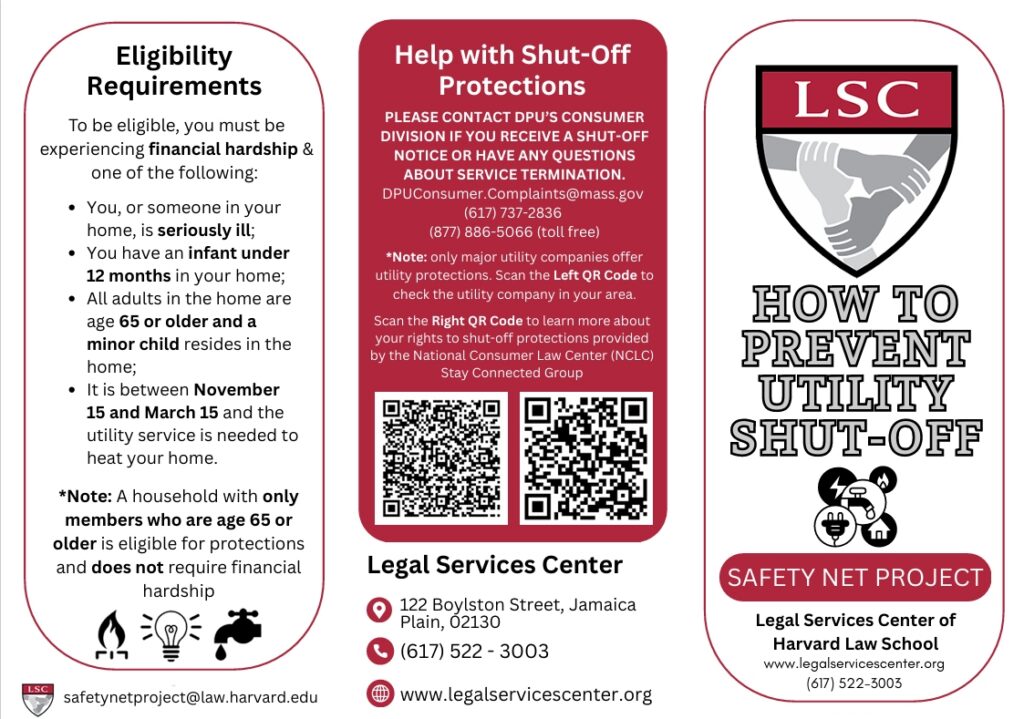
Massachusetts offers robust electric and gas utility shut-off protections to vulnerable populations. These communities include consumers who are seriously ill or experiencing financial hardship, and households with either infants or people 65 years of age or older. However, despite these state mandated shut-off protections, utility companies, with the Department of Public Utilities’ (DPU) approval, can still threaten consumers with service termination.
This is a problem that has really impacted the way the Safety Net Project works on utility cases here at the Legal Services Center.
One of our clients is a 70-year-old disabled woman who recertifies her shut-off protections yearly on her electric and gas accounts at Eversource and National Grid, Massachusetts’s biggest utility companies. She recently received a shut-off notice for a past-due balance. For our client, the added stress from receiving a shut-off notice had extreme ramifications on her health as she is dealing with multiple physical impairments that severely restrict her mobility. Our Safety Net Project team, as her legal representatives, agreed to help her assert her basic rights through elderly shut-off protection and to work to reinstate the protection on her accounts.
However, my supervisor Julie McCormack and I had to jump through many bureaucratic hoops. Even with the help of DPU employees, whom we enlisted to assist us in the protection process, it took two months to resolve this for our client. Unfortunately, not all consumers have access to legal advice and DPU representatives for help, and we know that our client is not the only person who has struggled to get their protections settled and access basic safeguards. If it took us two months of multiple phone calls, emails, faxes, and letters, how can unrepresented elderly and/or medically frail people be expected to successfully advocate for themselves?
The protection procedures for Eversource and National Grid are extremely unclear and navigating them is very challenging. For example, while the National Grid website prominently mentions shut-off protections, the Eversource website contains no easily accessed links or information. And Eversource’s elderly shut-off protections require a yearly recertification procedure that includes the provision each time of financial information and a birth certificate—despite the obvious fact that once a consumer is 65, they only age up and remain eligible for elderly protections.
Both National Grid and Eversource’s shut-off protection forms also require a signature from the consumer. The protection forms are online, and consumers may return their signed forms by fax, email, or mail. However, doing this requires a consumer to print out the form, sign it with a “wet signature”—one written on the document in ink—and go to a post office to mail it, or have access to a fax machine or the ability to scan the form to email it.
As a result, it is very difficult for many elderly consumers and/or those with a physical impairment that restricts their mobility to sign and return the forms without the help of reasonable accommodations or legal representation. The client I refer to has impairments that restrict the mobility of her limbs. She is unable to stand, walk, or lift anything with her arms and hands, so it becomes really difficult for her to obtain the forms, sign them, and send them back.
The Americans with Disabilities Act (ADA) section on Prohibition of discrimination by public accommodations (42 U.S.C. § 12182) states that utility services must provide “auxiliary aids and services for consumers with disabilities so they may communicate effectively with others.” This includes helping consumers with procedures like signatures and returning the forms. Yet utility services do not always comply with these extra procedural steps by allowing someone to bypass the wet signature and other requirements. Our client was never offered any assistance in this regard. Requiring signatures and other documentation without providing reasonable accommodations is blatantly discriminatory and poses an extreme burden and threat of termination on vulnerable populations.
Massachusetts Governor Maura Healy has taken a stance on equitable utility services, stating on the Boston 25 News that it is “imperative that energy consumers know their rights, including that they cannot have their utility service shut off during the winter months.” But she needs to go further in enforcing protections for all Massachusetts residents who are entitled to shut-off protection. No eligible consumers should be threatened with shut-off notices and the potential loss to life-saving access to heat, light, and electrical service.
Working on this case made me realize that this issue is bigger than one client. It reveals how a procedural failure by utility companies and government agencies to accommodate communities they are mandated to protect is a systemic issue that creates institutional barriers to thousands of people. The DPU and utility companies should not be allowed to continue to harm utility customers by routinely failing to comply with shut-off protection regulations. All eligible consumers deserve the right to uninterrupted gas and electricity services, and we all are entitled to fair, equitable treatment from our utility providers. The DPU and Massachusetts utility companies need to be held accountable for predictable, transparent, and straightforward protection procedures to ensure that all eligible and vulnerable communities can stay warm throughout the year.
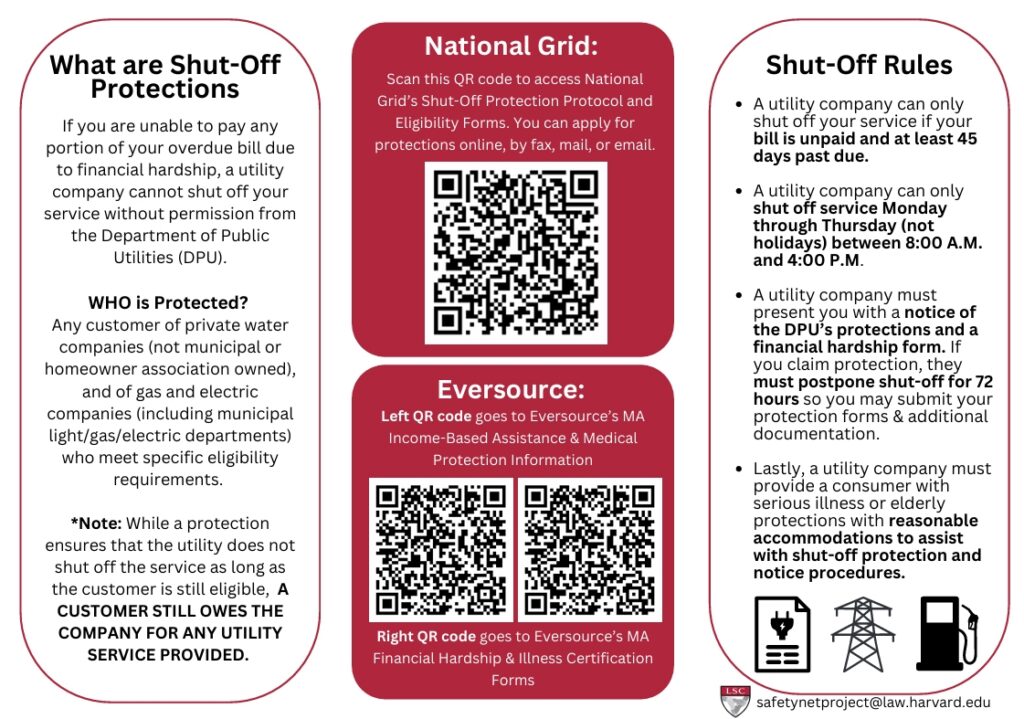
Please see this brochure for more information on shut-off protections.