By: Bianca Umaña-Taylor, Legal Intern, Safety Net Project & CORI Sealing
I had absolutely no idea what was in store for myself or the other Safety Net Project interns, beyond a free t-shirt, when we readily agreed to join other volunteers in advocating for the Clean Slate Act.
It wasn’t until that hot summer day on June 24, 2026, when we approached the iconic golden dome of the Massachusetts State House, that it fully set in the weight that this piece of legislation could have on the people looking for a fresh start and to fully contribute to society. An additional indicator that we had arrived at the State House was the group of protestors with large signs and megaphones arguing for another but likely equally important issue. The sense of urgency to make change was extremely prevalent in this atmosphere.
While we were provided some briefing on the proposed legislation by the team organizing the event, none of us had previous experience in legislative advocacy, and the act felt somewhat daunting. However, because of our work in sealing criminal records—also known as CORI sealing—we were in a well-suited position to understand its impact.
Put simply, the Clean Slate Act (S.1114) would replace Massachusetts’ current criminal record sealing process with a more automated version. If implemented as intended, it would allow for automatic sealing of eligible misdemeanors and felonies after three or seven years, respectively, provided no new offenses have occurred. It would also automatically seal non-convictions. In other terms, this would put the Safety Net Project interns out of our jobs, something we ironically want to happen.
The benefits of sealing include the ability for an individual to re-enter society, primarily by removing the legal and prejudice-driven barriers to obtaining housing, education, and employment. By witnessing our clients’ lives change through the current system of cumbersome, petition-based sealing, our participation in these advocacy efforts proved extremely relevant.
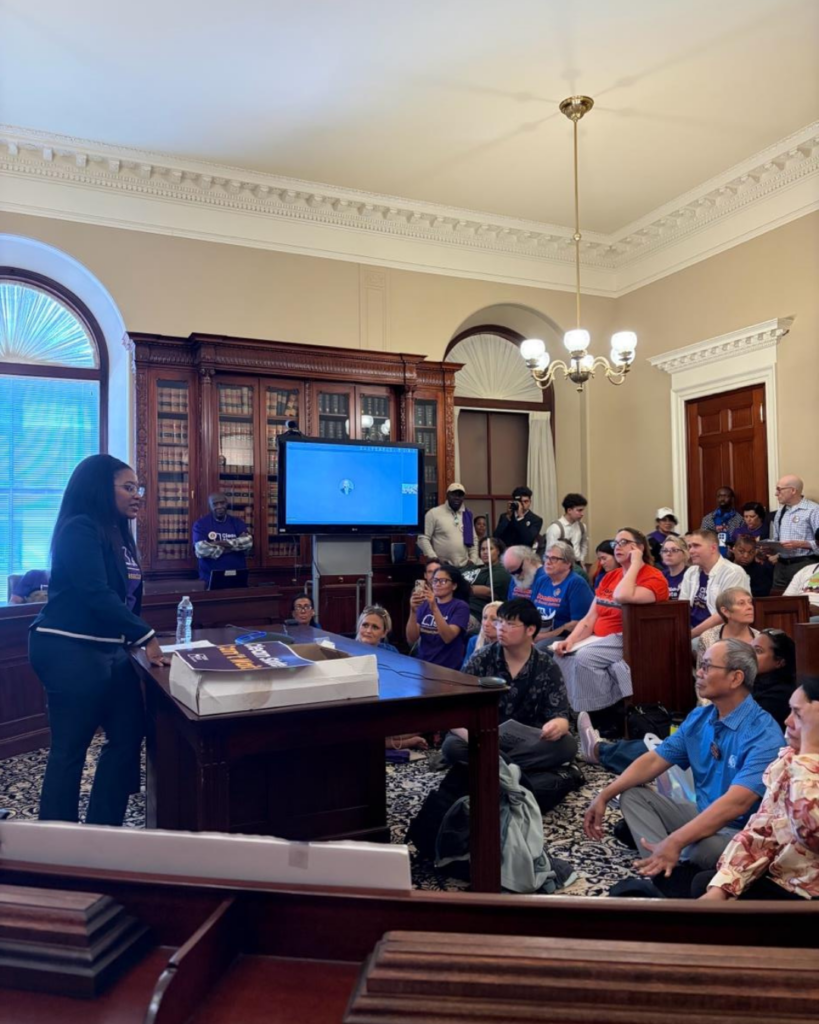
Once our eight-student team had gathered on the cold marble walkway that lined the second floor, we were given the proper materials to prepare us for our discussions with senators, representatives, and their assistants. Besides the Safety Net Project team, there were around 60 other volunteers from at least five different organizations coming together to advocate for this issue. See a list of Clean Slate Legislation endorsers here.
The team organizing this effort, Clean Slate Massachusetts, played a crucial role in bringing people together from various backgrounds and stressing the importance of the work we were about to engage in.
One of the most impactful moments of this experience was hearing personal stories from two formerly incarcerated individuals, whose experiences underscored the importance of an accessible record-sealing process. They spoke about the lasting barriers that criminal records create, specifically when seeking employment and housing long after they had completed their sentences. Their goal was to simply rebuild their lives and leave their pasts behind them. Re-entering society and contributing to the world in meaningful ways was their priority, but if outdated records of their past allow others to judge their character before getting to know them, opportunities become limited and the cycle of struggle continues.
Leaving that meeting with a heightened sense of purpose, we then paired off and visited legislative offices throughout the State House to explain why we were there and stress the importance of passing the Clean Slate Act. Speaking with members of both the House and the Senate allowed us to connect our client-facing work with broader policy reform, demonstrating how individual legal advocacy and systemic change influence one another.
While most of our conversations were with legislative aides and other staff members, we also had the opportunity to speak directly with several legislators. Those interactions felt especially meaningful, as we knew that their time was limited and each conversation required us to communicate the importance of the bill in a clear and concise manner. Our efforts were reinforced by the support many offices expressed for the Clean Slate Act, and we were even later notified that others decided to become co-sponsors after our visits.
Fajar Amjad, a student at Mt. Holyoke College interning with the summer Safety Net Project, reflected that the day “reaffirmed my faith in organized advocacy … people from different backgrounds came together due to shared ideals.” Her observation captured one of the most memorable aspects of the day: the collective strength of our advocacy.
Amjad recalled hearing someone at the State House jokingly remark, “there are so many of you here today, we can’t seem to get rid of you guys.” Our bright purple shirts emblazoned with the words CLEAN SLATE made our presence immediately recognizable, but our message proved even more lasting. As advocates visited office after office, staff members began recognizing our group and shared that they had already received “the spiel.” It became clear that our coordinated efforts had successfully amplified awareness of the Clean Slate Act throughout all corridors of the Massachusetts State House.
By the end of the day, policy advocacy no longer felt unfamiliar or reserved for others with extensive backgrounds in it. Instead, it became a tangible method to support the clients we work with every day by advocating for policy change that would impact lives we may never encounter.
This experience allowed the Safety Net Project interns to step beyond our individual client work and contribute to broader legislative reform, emphasizing the connection between direct legal services and state-wide policy advocacy. While helping clients navigate the current record-sealing process remains meaningful, the possibility of making such a process automatic poses as an increasingly impactful goal to work towards. I left the State House that day with a greater understanding of the role advocacy plays in producing administrative change and an appreciation for the ways individual voices can help shape public policy.
While the experience itself was enough to demonstrate the impact that advocacy has on policy, our understanding became much more meaningful just a few weeks later. On July 23, 2026, Senator Cindy Friedman successfully adopted Amendment 511, “Requiring Automated Criminal Record Sealing,” as part of an economic development bill (H.5576/S.3178). The amendment incorporates key Clean Slate provisions and marks an encouraging step toward the broader goal that brought us to the State House that day. Although there is still work to be done before automatic record sealing becomes fully embedded into Massachusetts law, seeing tangible progress on legislation we had supported highlighted how even first-time advocates can contribute to systemic change.
Pictured Below: Clean Slate Massachusetts emphasizing the importance of passing this legislation and briefing volunteers on how to advocate for it.