As a second-year law student, Neha Aluwalia ’26 had never taken a deposition in a lawsuit—let alone the deposition of a lawyer in a major class action case.
Yet a week before finals last fall, Aluwalia, a student in the Consumer Protection Clinic, faced off against the defendant attorney in Royal v. Metcalf, a class action suit alleging unfair debt collection practices in violation of Massachusetts law. Filed in 2023 by the Clinic and its co-counsel, the National Consumer Law Center (NCLC), the case alleged that a debt collector and purchaser, and his attorney, sued hundreds of people in small claims courts throughout the state collecting amounts not actually owed and failing to prove they owned the debts.
For over three hours, Aluwalia grilled the lawyer with questions she’d prepared and practiced for weeks under supervision of lawyers at the Clinic. Her clinical classmates also took turns playing the role of the defendant to help hone her approach. “They were different levels of responsive and aggressive, so I got used to doing it on my feet,” she recalled.
The actual deposition “went very smoothly and we covered a lot of ground,” said Aluwalia, who described the lawyer as “very respectful. I really appreciated that. I wasn’t sure what to expect given that he was attorney.” Aluwalia was joined at the deposition by Alexa Rosenbloom, director of the Consumer Protection Clinic, and Jennifer Wagner, a senior attorney at NCLC, and could seek their guidance if she wished. And she felt ready to pivot as needed during questioning. “As much as we prepared, it was nice to be able to lean into my intuition and respond to something he said,” she said.
“At a law firm, it might take couple years to get that experience,” she added. “It was definitely scary but I loved the experience.”
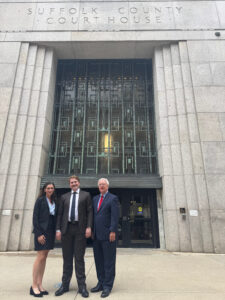
And a successful one. This summer, a Suffolk County Superior Court judge certified the class and granted summary judgment to it, ruling that the debt collector’s actions violated Chapter 93A, Massachusetts’ consumer protection statute. About a month later, the court entered a final judgment and awarded restitution to class members who made payments to the defendants and vacated all judgments against the class.
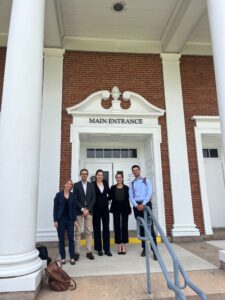
In September 2025 at Somerville District Court, 4 Consumer Protection Clinic students joined Clinic Director Alexa Rosenbloom to participate in small claims trials.
Eight or so students in the clinic worked on the case over several semesters, under the supervision of Rosenbloom,Roger Bertling, former director of the Clinic, who retired last June, and Stuart T. Rossman ’78, former litigation director of NCLC, who worked on the case there before joining LSC last year as an Access to Justice Fellow.
And that wasn’t the only class action victory for LSC this summer. In July, the Veterans Legal Clinic succeeded in getting class certification for military veterans who’d served honorably for a period of time but were denied a “Welcome Home” bonus from Massachusetts because their final discharge was less than honorable— often due to mental health conditions, discrimination, and other experiences in service.
“It was nice timing that we got these decisions very close to each other,” said Rosenbloom.
The Veterans Legal Clinic is currently in discussions with the Massachusetts Attorney General’s office about next steps to notify and implement class relief in the case, said Dana Montalto, associate director of the Veterans Legal Clinic. Since the filing of Machado v. Goldberg eight years ago, Montalto has supervised more than a dozen students who’ve drafted, filed, and argued motions in what is widely called the “Welcome Home Bonus” case.
“The Welcome Home Bonus case is a shining example of LSC’s model: a veteran reached out to LSC because he had the sense that his being denied benefits was unjust,” said Montalto. “And from the very beginning student attorneys have taken the lead in investigating this novel legal issue, building strategic litigation, drafting briefs and motions, and arguing in court. This signature victory would not have happened without the hard work of so many devoted law students.”
“This whole case was quite challenging,” said Jack Regan, a U.S. Navy veteran who began working on the case as a partner in a major Boston firm, and continued on it when he joined the Veterans Legal Clinic in 2019 as a Senior Fellow. “There was no playbook that the students could readily consult about what to do next, especially about some of the novel positions taken by the Commonwealth to defend its interpretation of the statute and to defeat class certification. Hard thinking and innovative, energetic lawyering were required at all stages.”
Jett Watson ’26 (center) with Dana Montalto, Associate Director and Jack Regan, Senior Fellow Veterans Legal Clinic.
“It’s such a master class in complex ligation,” echoed Jett Watson ’26, who, with Kyra Du’25, filed a supplemental motion for class certification last May and argued it over the summer, andblogged about his experience. “Class actions are big, complicated cases, with a lot of rules that sometimes conflict with each other . . . you have to think strategically.”
As a second- and third-year law student in the Veterans Legal Clinic, Laurel E. Fresquez ‘19 not only helped an individual veteran land a discharge upgrade but also worked on the class action. She and Joshua T. Mathew ‘19 represented three veterans on behalf of the proposed class who’d been denied the bonus. They met with the veterans, prepared initial filings and briefings, and then argued before the court.
“We explained the complexities of military jargon in a simple way that helped the Court realize that the State was making a mistake based on their own misunderstanding of military discharges,” said Fresquez, now an associate with a law firm in Washington, D.C.
“I got to practice oral argument in a way I never could have otherwise—and in a way that I still haven’t as a lawyer at a law firm.”
A court ruling in favor of her clients laid the groundwork for the class action, and when the class was certified this summer, Fresquez framed a Boston Globe article about it and hung it in her office. “It’s one of my proudest accomplishments!” she said.
In an example of cross-clinical collaboration, Watson was mooted before the argument by Rosenbloom and Rossman, two lawyers deeply experienced in consumer class actions. Indeed, when Rossman, a nationally renowned expert in class actions, joined LSC in 2024, he reached out to its five other clinics to offer his expertise. “A lot of students express interest in working with Stuart. To have this national expert in-house, we are really lucky,” said Rosenbloom.
Class actions are a critically important tool for aggregating claims of plaintiffs who individually don’t have the resources to hire a lawyer, or whose individual claims don’t offer an opportunity for a big payout. “As important as class actions are in antitrust securities cases, they’re absolutely vital in poverty law. It’s the only way that a little guy can stand up to government or big business,” said Rossman.
The top priority in Metcalf was to stop the defendants from harming consumers through their illegal debt collection practices, said Rossman, and to garner restitution for the wronged class members. “If that’s all we achieved, we’ve done a great service,” he said.
“While class actions can be a confusing and complex procedural tool, they really present a great chance to see how plaintiffs can leverage that unique tool to get justice for hundreds if not thousands of folks who would have never had their day in court otherwise,” said Matt Bailey ’26, who with another student drafted the briefing in Metcalf seeking class certification and summary judgment.
“The drafting process involved a lot of back and forth with our supervisors, so my legal writing significantly improved and received individual attention in a way that more general academic settings . . . hadn’t really allowed for,” added Bailey, who will be joining a firm in New York, where he will focus on plaintiff-side work including consumer class actions.
In the Welcome Home Bonus case, as well, the experience was “very writing heavy, with quite a lot of research,” added Watson, who has returned to the Veterans Legal Clinic this year and is continuing work on the case. “But it’s been a ton of fun.”
In class actions, “You’re developing incredibly useful litigation skills: briefing, legal research, client contact, case development—all the things that are useful for any lawyer, particularly litigators,” said Rosenbloom. Montalto noted that these cases also foster skills in decision-making and project management.
“The Metcalf and Welcome Home Bonus class action successes reflect a real strength of LSC’s advocacy model, where our work in the trenches every day on behalf of individual clients enables us to look for patterns and develop strategies to attack a problem at its root,” said Daniel Nagin, faculty director of LSC and of the Veterans Legal Clinic. “And as in all things at LSC, our amazing students are at the forefront at every stage.”
This semester, as an advanced student in the Consumer Protection Clinic, Aluwalia continues to work on Metcalf, on a post-judgment motion. “The class action was such a formative experience really early on in my legal education,” said Aluwalia, who after graduation will work in the litigation department of a firm in Washington, D.C., “and I’m just very grateful for it.”